


Baby Monkeys, AI Chatbots, and the Future of Humans
- Feb 5
- 3 min read
If you studied psychology in college, you might remember Harry Harlow’s monkey experiments[1]. They were disturbing, but enlightening. I have a permanent image in my head of a desperate baby monkey frantically trying to seek soothing and comfort from a wire “mother” who fed it and a cloth “mother” who “comforted” it. These monkeys were removed from their mothers at birth, and instead, offered wire and cloth substitutes. (They generally preferred the cloth “mother” except when they were hungry.)
The mental picture of these distressed animals is unforgettable, but the outcomes suffered by them helped social scientists understand that emotional and social connections were at least as important if not more so than food to baby monkeys. These findings led us to understand the need for infants and children to bond and connect to their caregivers. In other words, a human caregiver is essential to a human infant’s development.
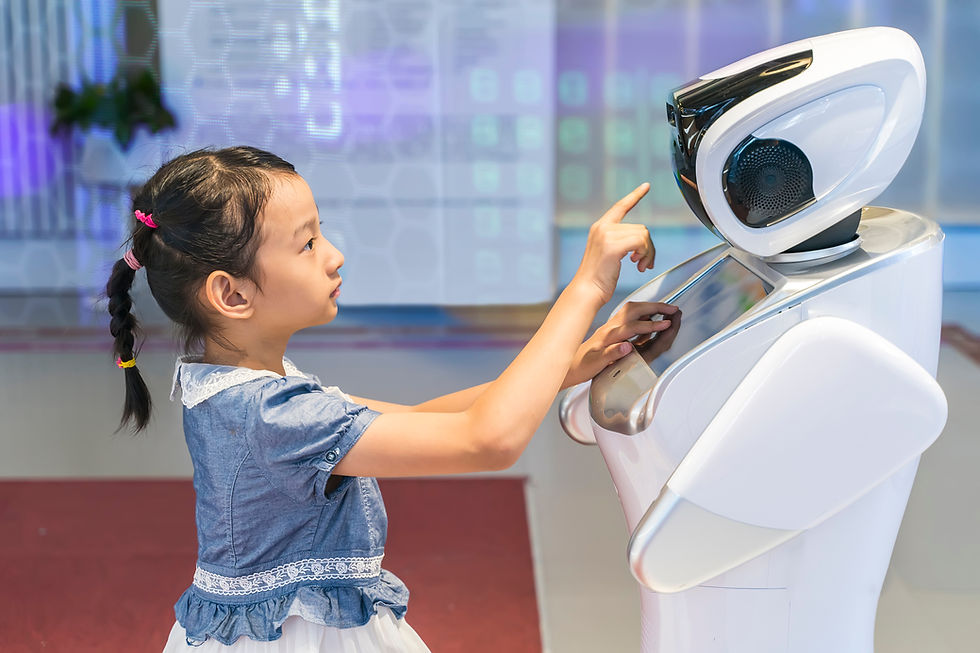
Today we run the risk of putting our human infants in the care of a robot programmed to behave like a human. Historian, philosopher, and author, Yuval Noah Harari, asks us to consider what might happen to a human baby raised by artificial intelligence[2].
When I really think about what is behind what moves me to write, it is always about our basic humanity. One of the best exposés on this issue was published a few days ago. It speaks to the need to focus on being human when AI, technology, and screens are begging us to hang up our humanity and succumb to big tech’s dreams for the future.
In this essay, Freya India[3], speaks to a future when behaving like a human is frowned upon. The homogenized world that AI creates won’t like it when we think, speak, and act on our own. It won’t like it when we have ideas of our own, new ones that haven’t been entered into the AI data bank of knowledge. Ms. India celebrates and encourages the messiness of being human. “Hear, hear!” I say.
So what’s the point? The people pouring billions into AI want us to give our children a chatbot to see them through life. These chatbots will do whatever our children ask of them. Write an essay. Contact mom and ask what’s for dinner. Tell the teacher that Billy isn’t paying attention. Take a test? Why not if the teacher isn’t looking. (Maybe by then, the teacher will be a robot.) It sounds futuristic and awful, but it is at our doorstep.
The tech companies are spending a lot of money convincing educators and schools that they can’t prepare our children for the future without AI in the classroom—technology that the taxpayers will have to fund. They said the same thing to us about computers. They even told us that without their screens in front of every child’s face, we would be failing our children, and we bought it. To my mind, kids would have figured out how to use computers just fine without having them take over our classrooms.
Where did this get us? Not to a good place. Kids prefer the world of virtual reality through a clunky headset that blocks out the real world. College kids can’t or won’t read books. Teens seem ready to avoid dating a fellow human when a chatbot will meet their needs. Parents get lost in their iPhones and miss their children’s childhoods, unless of course they are photographing every moment of their kids’ lives and posting it on social media. We are tired, distracted, lonely, depressed, stressed, and disconnected. We don’t know how to talk to each other, and our civil discourse has turned into a mosh pit.
There is a movement underfoot among educators to get screens out of the hands of children and replace them with books printed on paper. I support it wholeheartedly. The more we let technology replace us, the less human we will be.
So this brings me back to the robot caregiver that is probably already being marketed to new parents and daycare centers. Humans need real humans, not fake humans, to become humans.
The tech companies are selling us a bill of goods. We shouldn’t buy it, but it is very likely that we will. We need to take a pause. Welcoming a world where AI (and screens) replace our humanity is a bad thing.
Don’t forget what happened to Harlow’s baby monkeys. Please.
[3] https://www.afterbabel.com/p/you-have-to-be-human?utm_source=substack&publication_id=1221094&post_id=186015683&utm_medium=email&utm_content=share&utm_campaign=email-share&triggerShare=true&isFreemail=true&r=4pcpm3&triedRedirect=true



The monkey preferred the cloth mother. The desire for comfort and bonding is present in humans, not just baby humans. That’s a big part of the reason that we fear a tech takeover and that people recognize their addictions to our screens and call this phenomenon a crisis. The innate desire for human connection is the antidote to the dystopian future we fear. The challenge is to find more ways to support human connection at a time when technology appears to be extinguishing that spark of life.